Why one AI agent isn't enough: Multi-agent strategy for brands
How specialized AI agents deliver deeper analysis than a single prompt
9 min read
1. The Problem with a Single Prompt
Most companies using generative AI for strategic tasks rely on a single prompt: “Analyze my brand and create a strategy.” The result is predictable – superficial, generic, incomplete.
The reason lies in the architecture: a single AI agent tries to simultaneously be a brand expert, website auditor, market researcher, and strategy consultant. This overwhelms even the most capable language models. Important dimensions are skipped, analyses remain surface-level, and recommendations are too general to be actionable.
2. What Multi-Agent Systems Do Differently
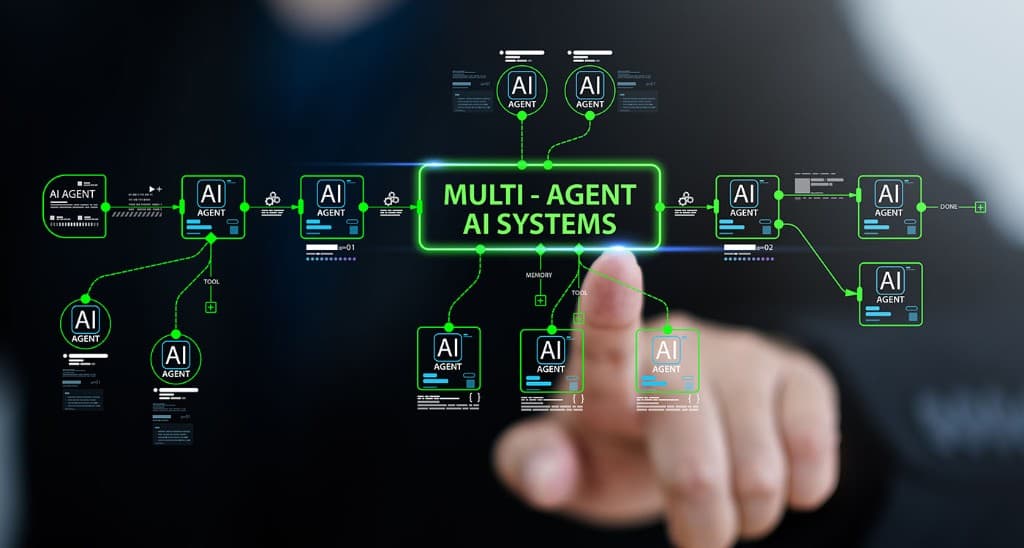
Multi-agent systems (MAS) solve this problem through division of labour. Instead of one “jack of all trades,” multiple specialized agents work in parallel, each with a clearly defined focus.
Specialization: Each agent is trained for a specific domain – brand analysis, website auditing, competitive research, or strategy development.
Parallelization: Agents work simultaneously, drastically reducing total processing time.
Triangulation: Results are merged and cross-checked – contradictions become visible.
Depth over breadth: Each agent can dive deep into its subject instead of covering everything superficially.
The concept is well known from software engineering: microservices – small, specialized services that together form a complex system. Multi-agent systems apply this principle to AI-powered analysis.
3. A Concrete Example: 4 Agents, 4 Perspectives
Consider a brand analysis with four specialized agents:
Agent 1: The Brand Analyst analyzes brand documentation: purpose, personas, identity, coherence. Rates the brand with a Brand Score and six radar dimensions – positioning, identity, target groups, coherence, communication, differentiation.
Agent 2: The Reality Checker compares brand documentation (target) with the website (reality). Systematically checks design, UX, SEO, trust, and content, creating a gap analysis with visual priority bars.
Agent 3: The Competition Researcher researches the market, analyzes competitor websites, and identifies market gaps, unoccupied positions, and differentiation potential. This agent performs active web research – something a single prompt cannot do.
Agent 4: The Strategy Developer based on all results, develops a concrete action plan in three time horizons: immediate measures (0–4 weeks), short-term (1–3 months), and medium-term (3–12 months). Defines KPIs and identifies risks.
The result: a visual dashboard with scores, radar chart, and gap analysis – plus a detailed strategy paper in six chapters. In three to five minutes.
4. Why “Faster” Doesn't Mean “Worse”
A common objection: Can an AI analysis in five minutes be as good as manual consulting over weeks?
For the assessment: Yes. AI agents can process more data in minutes than a consultant can in days. The website is systematically crawled, competitors are analyzed in parallel, and brand documentation is checked against established frameworks.
For strategic depth: Partially. AI provides a strong starting point. The 80/20 rule applies: 80% of insights can be gained automatically. The remaining 20% – cultural nuances, implicit brand knowledge, political dynamics – still require human expertise.
For the price: Clearly. A traditional brand strategy project costs CHF 15,000–50,000 and takes four to eight weeks. An AI-powered strategy report makes comparable insights accessible for a fraction of that budget.
5. The Technical Foundations
Multi-agent systems for brand analysis are built on three key technologies:
Orchestration: A central coordinator distributes tasks to specialized agents and collects results. In research, this pattern is known as the “orchestrator-worker” architecture.
Context sharing: All agents work on the same data – brand documentation, website data, market information – but interpret it from their specialized perspective.
Streaming results: Instead of waiting for all four agents, partial results are streamed live. Users see progress in real-time – a crucial UX advantage over traditional batch analyses.
6. Implications for Brand Management
Multi-agent systems change not just the speed of brand analysis but also its accessibility. Until now, a solid brand strategy was a privilege of large companies with corresponding budgets. AI-powered multi-agent analyses democratize this process:
Startups can perform professional brand analysis from day one. SMEs get regular strategy updates instead of one-off projects. Agencies can deliver pitch preparations and competitive analyses in hours instead of weeks.
Conclusion
A single AI prompt cannot replace a brand strategy. But a system of specialized AI agents working in parallel and triangulating their results delivers insights that were previously reserved for expensive consulting projects. For companies of any size, the question is increasingly not whether but how quickly they adopt this technology.
This article is based on experiences developing multi-agent systems for brand analysis at nuwai.